

Ending Isolation:
Travels with the Journey to Justice Bus Tour
Ending Isolation is a book that is written to empower former and current incarcerated people, and to weaponize activists working to end solitary confinement in the United States’ prison industrial complex. Here, contributors to the book discuss why and how they chose to write the book, and the impact that it had as an activist tool.
Text by Christopher Blackwell and Deborah Zalesne, with Dr. Terry Kupers and Kwaneta Harris.
—————————-
In the cold isolation of solitary confinement, the day unfurls like a monotone canvas, devoid of the sun’s warmth upon the skin, or the laughter of shared moments with other humans. The grinding monotony of idleness, hunger, uncertainty, and madness is the horrifying everyday reality for close to 125,000 people incarcerated in American prisons today.
For over two hundred years since its conception at Eastern State Penitentiary, better known as Cherry Hill, solitary confinement has been a dark tomb of extreme isolation, harm, and abuse. According to the U.N., the use of solitary confinement for more than 15 consecutive days is torture. It has been proven to cause high levels of mental pressure, leading to breakdowns of the mind and soul. Nonetheless, in the United States it is not uncommon for incarcerated people to be forced to endure solitary confinement for many months, years, or even decades at a time. And most people in solitary are being punished for minor infractions. Despite the severe harms it causes, we continue to allow prison administrations to weaponize this draconian practice simply to maintain dominance against those within their care. But we as a society are the recipients of the damage it inflects upon our fellow citizens through the harm they cause upon returning to our communities.
This is why we chose to write the book Ending Isolation. In it, we explore the profound impact and harrowing consequences of an isolated existence on the human psyche. Through our shared experiences as incarcerated people and our knowledge as lawyers and medical experts, we show that solitary confinement causes mental illness, and argue that prolonged solitary confinement in every instance is per se cruel and unusual punishment in violation of the Eighth Amendment of the Constitution.
The book is built on incarcerated journalist Chris Blackwell’s continuing experiences in solitary confinement, which are interwoven with testimonials from incarcerated people from around the country, including Kwaneta Harris, a prison journalist who spent eight and a half years in solitary confinement. Throughout the book, we’ve also included testimony from Dr. Terry Kupers, one of this country’s leading medical experts on the harms caused by extreme isolation. Through these stories and the undisputed medical research that shows that solitary confinement causes mental illness, we argue that prolonged solitary confinement in every instance is per se cruel and unusual punishment in violation of the Eighth Amendment of the Constitution.
We share the origins of solitary confinement, how we allowed this practice to grow into what it is today, and the current state of law around it. We describe in detail abusive practices that occur regularly in solitary, such as extreme physical and sexual abuse, the withholding of food, water, mattresses, tampons, medicine, and other necessities, and other stories of torture. We highlight the inexcusable treatment of juveniles in solitary, racial disparities regarding who is sent to solitary and how people are treated, and environmental justice issues related to the practice. Ultimately, we discuss workable alternatives to solitary confinement (such as separation without isolation), the reforms that have occurred in some states, and the advocacy happening today to bring those reforms to life and actually end the destructive use of this archaic practice in the US and abroad.
The book is unique in that it is being used as a tool to educate those who do not know much about solitary confinement and a guide for those in the fight to end solitary confinement altogether. The barbaric use of solitary is so pervasive in our carceral system simply because it has become normalized. Our hope is that hearing directly from impacted people and witnesses to the abuse and torture will change that.
The Journey to Justice bus tour took our campaign to end solitary confinement across the country, from Washington State to Washington D.C. Blending artivism, public education, and immersive experiences, the repurposed bus served as an advocacy hub, featuring a mobile library, immersive exhibits, and a life-sized solitary cell. The book was at the heart of all this activity, and was picked up and read by the people we met along the way.

The Journey to Justice bus at Eastern State Penitentiary, Pennsylvania, the birthplace of solitary confinement
The bus tour, also included theater performances, film screenings, and poetry slams, with dialogue sparked by book readings at every stop.
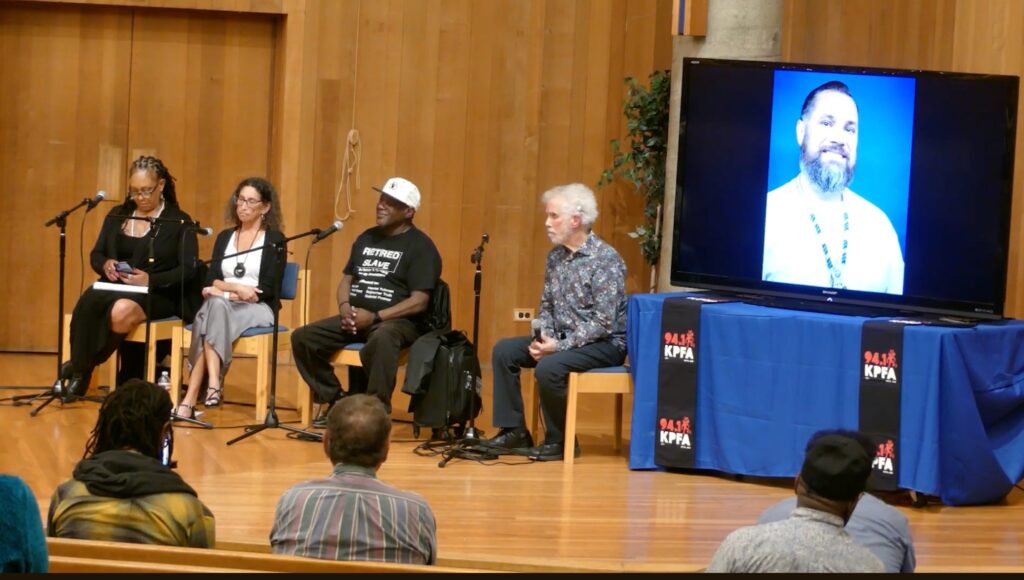
Cat Brooks, Deborah Zalesne, Dorsey Nunn & Terry Kupers with Christopher Blackwell on screen, at the Sept 4 Berkeley kickoff event sponsored by KPFA Radio, Unlock the Box, and Look2Justice
Along the way we met with many state and federal legislators, including Massachusetts Senator Edward Markey, the sponsor of the End Solitary Confinement Act. This Bill would hugely limit solitary in the Federal Bureau of Prisons and ICE detention facilities and would encourage states to follow suit because extra federal funds to state Correction Departments would be tied to their following the federal guidelines on Solitary. A large proportion of folks who showed up at events were survivors of solitary confinement, who advocated, educated, and inspired.
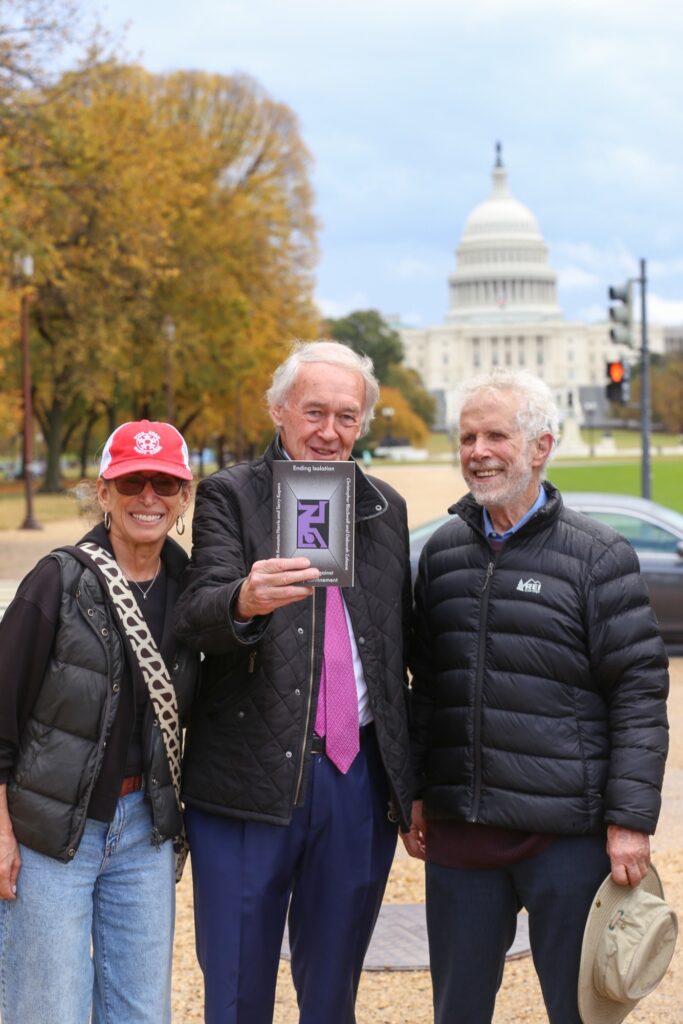
Senator Edward J. Markey (Democrat Massachusetts) with Prof. Deborah Zalesne and Dr. Terry Kupers on the national mall in front of the Capitol.
The fight to end solitary confinement is, at its core, a fight for our shared humanity. The Journey to Justice bus tour and Ending Isolation both illuminate the suffering too long hidden behind prison walls and call our nation to act with compassion, reason, and justice. Every person deserves dignity, connection, and the chance to heal. By ending the use of solitary confinement, we take one step closer to a society that truly values human life.